In Defence of the Small Phone
There is a drawer
There is a drawer in my flat with an iPhone 6s in it. The battery is a rumour, the camera paints rather than photographs, and it takes about a minute to open anything. Every time I pick it up I get the same small shock.
This is the correct size.
It disappears into a hand. No re-grip, no shuffle, no wrist adjustment. It is just there, the way a set of keys is there.
Then I pick up my current phone and my hand does the thing. You know the thing. The reposition. The slow crawl of the thumb toward a button in the far corner, arriving like a climber who has run out of rope.
I have small hands, and somewhere around 2016 the industry decided hands like mine were a rounding error. So I went and got the numbers, because "it feels too big" is not an argument. They are worse than the feeling.
This is not nostalgia, it is arithmetic
| iPhone 5s | iPhone 6s | iPhone 17 Pro Max | |
|---|---|---|---|
| Screen | 4.0 in | 4.7 in | 6.9 in |
| Width | 58.6 mm | 67.1 mm | 78.0 mm |
| Height | 123.8 mm | 138.3 mm | 163.4 mm |
| Weight | 112 g | 143 g | ~233 g |
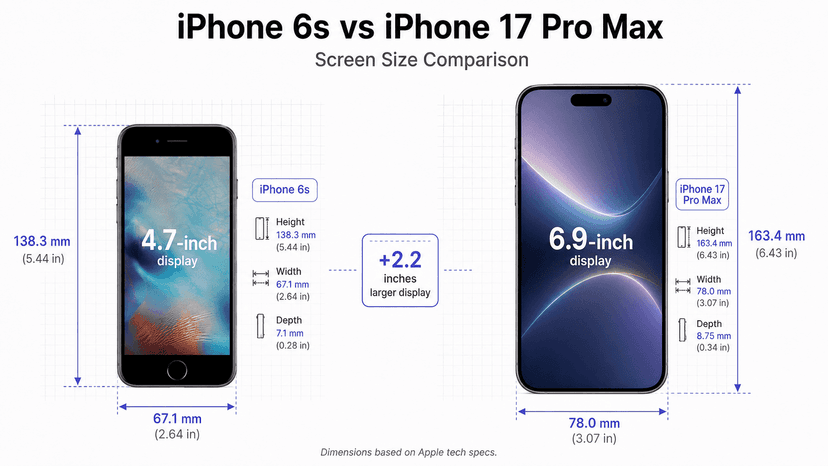
Two phones, one decade, 25 mm of extra body.
Screen diagonal is a sneaky number, because area grows with the square of it. The 6.9-inch panel is not 47% more screen than the 6s. It is nearly double, and about two and a half times a 5s. The body follows: a 17 Pro Max covers 37% more table than a 6s and weighs more than two of the phones I was perfectly happy with in 2014.
But the number I care about is the boring one in the middle. The 6s is 67.1 mm wide. The 17 Pro Max is 78.0 mm. Eleven millimetres sounds like nothing, and it is the difference between a phone you hold and a phone you manage.
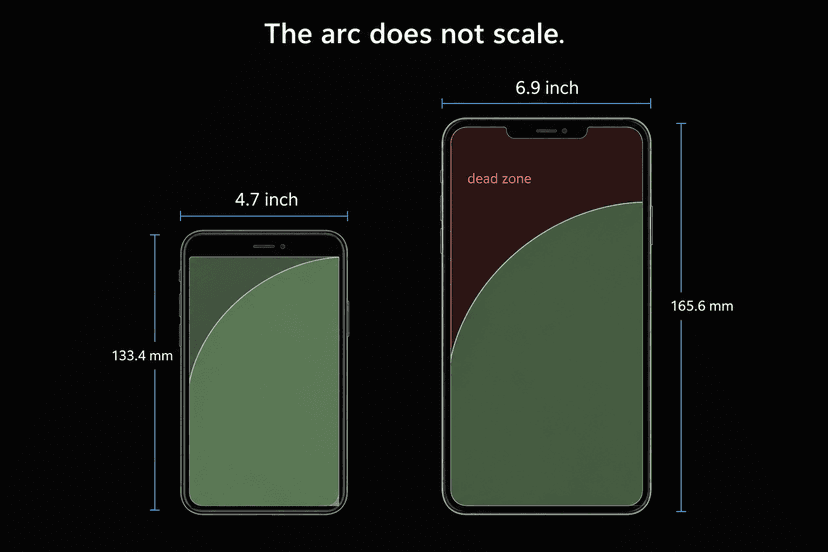
Same thumb, same arc, very different usable screen.
The thumb did not get a spec bump
Your thumb is a lever anchored near the base of your palm, and it sweeps an arc. The radius of that arc is set by your hand, which was finalised about two hundred thousand years ago and has not shipped a revision since. The screen got a new size every September.
Height you can cheat. Slide the phone down your palm, tap, slide it back. Ugly, but it works.
Width you cannot cheat, and width gets charged to you twice. Once because your fingers have to span it just to hold the phone, which pulls your thumb base outward and flattens the arc. Again because the thumb then has to cross that same extra distance.
The funniest evidence is that the manufacturers already admitted it. In 2014, the year the iPhone got big, Apple shipped Reachability, a feature whose entire job is to slide the top of the screen down because you cannot get to it. Android later shipped one-handed mode system wide. Two of the largest engineering organisations on the planet agreed their own hardware had outgrown the human hand, and shipped a workaround instead of a smaller phone.
Nobody ever needed Reachability on a 5s.
The pinky shelf
The second problem is leverage. On a 5s the whole phone sits inside your palm, mass low and supported. On a 6.9-inch phone a good chunk hangs past it, so the top half is a cantilever and gravity gets a longer arm to pull on.
Which is why everyone with a big phone has invented the same fix: curl the little finger under the bottom edge and let the phone rest on it. Enough people complain about the dent that "smartphone pinky" is a phrase that exists. A product category so heavy it renamed a finger.
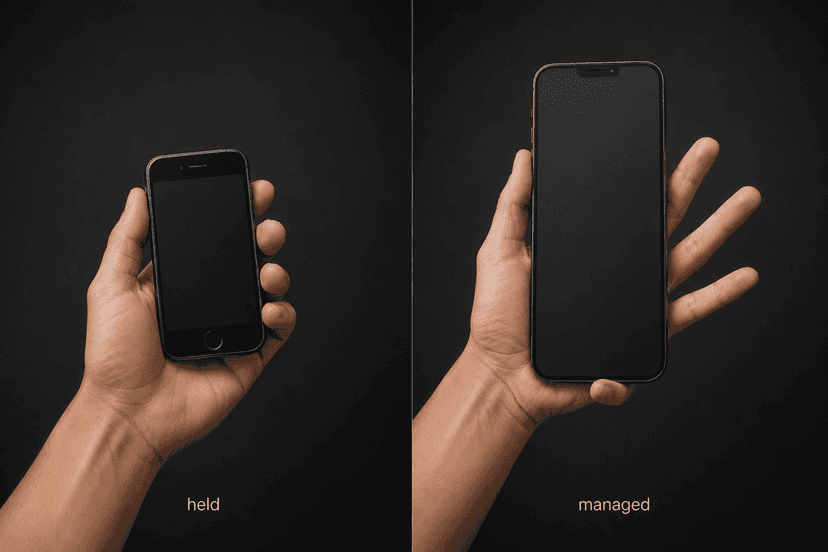
Left, the fingers rest. Right, they work.
The shape changed too
The 5s and 6s were 16:9. Today's phones are 19.5:9 or thereabouts, because width is the dimension your hand complains about immediately and height is the one nobody notices in a shop. Phones grew along the axis that generated the fewest complaints.
I thought that was the end of the story. It is not.
19.5:9 is almost exactly the shape of a vertical video.
The screen is now the size and shape of one unit of feed content. One video, edge to edge, no sidebar, no next item peeking in, no world. Whether anyone planned it or it simply fell out of the process, the display ended up shaped like a single serving of the most compulsive media format ever built.
We did not just make the phone bigger. We made it feed-shaped.
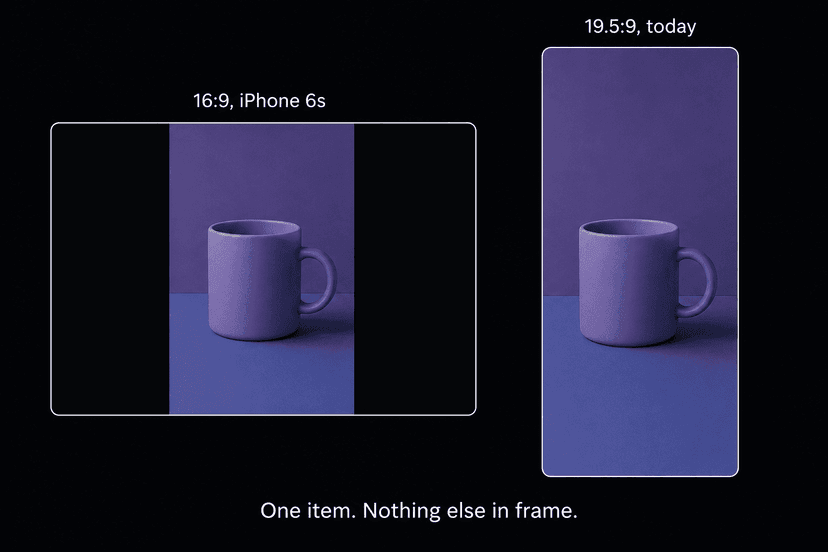
The old screen made room for the video. The new one is the video.
How a bigger screen quietly eats your day
I started out annoyed about my thumb and ended up convinced the size is doing something to my attention.
A small phone is a glance device. You use a 5s on a train holding the rail, walking, with a coffee in the other hand. One hand, ten seconds, done. The interaction has a natural end, because your other hand is busy being a human being.
A big phone is a destination. Anything past a lazy scroll needs both hands, which means stopping whatever else you were doing. So you sit. You settle. Nobody sits down with a phone for ninety seconds. The posture went from "in passing" to "committed", and session length followed. The phone stopped being a tool you use in the gaps of a day and became a place you go.
Friction used to be a brake. Small screens were mildly bad at anything long. Reading was squinty, video was tiny, typing was a chore. That badness was a stopping point. Every inch of screen since has removed one more reason to stop, and nobody has been working on adding reasons to stop.
Every swipe pays out more. A feed is a variable reward machine and the screen is the size of the reward. Double the viewport and each flick of the thumb delivers roughly double the novelty for the same effort.
And the phone ate the other screens. A 6.9-inch phone at reading distance fills about 30 degrees of your vision top to bottom. A 40-inch TV two metres away fills about 14. I checked this with a tape measure on a Tuesday night, which tells you plenty about my evenings. Your phone is, in the only sense your visual system cares about, more than twice the TV, except the TV lives in a room you eventually walk out of. The phone comes to bed.
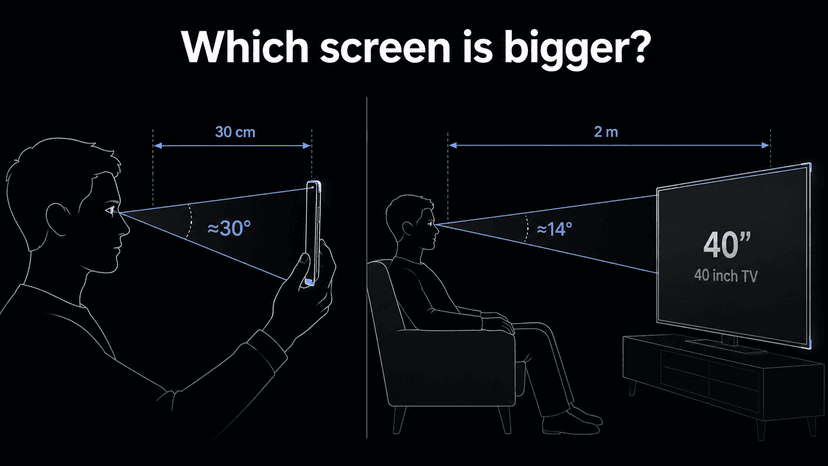
The tape measure disagrees with the marketing.
I was not more disciplined in 2015. I was holding a much worse doomscrolling machine, and it did me the enormous favour of being annoying to use for long.
To be fair to the people who did this
There is no conspiracy here. Batteries scale with volume, and battery life is the most requested feature in the history of the category. Cameras need room, because sensors and periscope lenses have dimensions that are not negotiable with a wish. Big phones sell, and for an enormous number of people the phone is not a companion to a computer, it is the entire computer. Size is a price ladder, because Max and Ultra are the high margin tiers.
Every one of those is reasonable on its own. Stack ten years of them and the small option stops existing at any price.
The mini did not fail, it was set up to fail
Someone always points at the 12 mini and the 13 mini. They existed, they sold badly, they got replaced by a Plus. Market spoke, case closed.
Look at what the choice actually was. The mini never got the telephoto, the best display and camera lived on the Pro and Pro Max, and it had the smallest battery in the lineup. Nobody in a shop was choosing between "small" and "big". They were choosing between "small, worse camera, worse battery" and "big, everything". Size was bundled with capability, capability won, and the result got written up as proof that people prefer big phones.
Small was never on trial as a flagship. It was on trial as a compromise tier, and compromise tiers always lose. Put the best chip, display and camera in a 5.4-inch body, charge flagship money, remove nothing, then see what happens. Nobody has run that test, and until somebody does, "small phones do not sell" is a claim about bundling, not about hands.
The closest anyone got was Asus, with the Zenfone at 5.9 inches and real flagship internals.
The word is right there in the name
I am not asking for 2015 back. Keep the silicon, keep the OLED, keep the computational photography witchcraft. Just stop growing the body. Give me 5.5 inches, under 70 mm wide, under 160 grams, with the good camera in it, and I will pay Pro Max money without blinking.
We call it mobile. Portable. Pocket. A device you have to plan your grip around, hold with two hands, prop on your little finger and put down because your wrist has had enough is not really any of those things. It is a small tablet with a phone app on it, and we have all agreed to keep using the old word.
The 6s fit in a hand and in the gaps of a day. My current phone fits in neither. It fills the hand, fills the pocket, fills the gaps, and now that it is big enough to fill an evening too, I think we traded away something we never bothered to put a price on.
The drawer is still there. Battery dead, screen scratched, absolutely useless.
Still the right size.